— Understanding K-POP’s “Big 4” through sound and operations
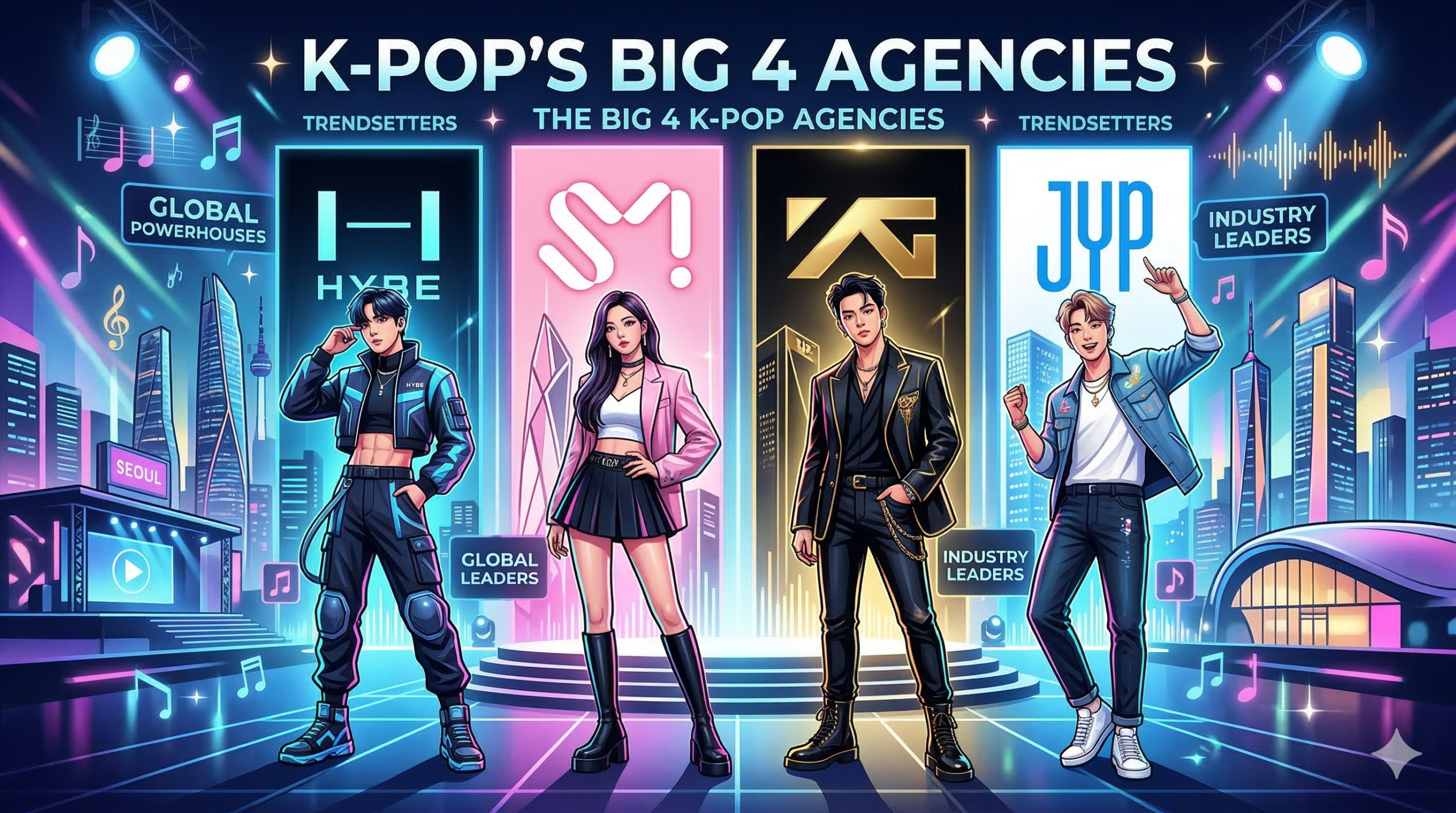
When people talk about K-POP’s industry structure, the term “Big 4” comes up constantly: SM, YG, JYP, and HYBE (a group built around the former Big Hit and expanded through a multi-label model). What makes them “big” isn’t only hit songs—it’s a system: trainee development, production pipelines, concept/IP building, fandom touchpoints, and global rollout engineered as one package.
This article organizes each company by founder DNA, flagship artists, musical identity, and operational strengths. The point isn’t to rank them; it’s to understand their different “design philosophies”—and how those philosophies show up in both sound and branding.
SM Entertainment: Building “formats” with world-building and high-density production
SM is strongly shaped by producer-founder Lee Soo-man. SM’s signature move is packaging: concept, visuals, narrative, performance, and arrangement density working together, making each comeback feel like a chapter in a larger format.
-
Representative artists
TVXQ!, Girls’ Generation, SHINee, EXO, Red Velvet, NCT, aespa -
Musical keywords
Layered vocal arranging, structural turns (bridges/modulations), and detailed sound design—pop that wins through density and precision. -
Operational traits
World-building and multi-unit thinking create many “entry points” for fans and keep long-term storytelling alive.
YG Entertainment: Turning hip-hop “attitude” into pop-star power
YG’s lineage traces back to founder Yang Hyun-suk and a hip-hop-first sensibility. Here, hip-hop is less a genre box than an attitude: character voices, timing, groove, and stage presence often matter more than technical polish.
-
Representative artists
BIGBANG, 2NE1, WINNER, iKON, BLACKPINK -
Musical keywords
Heavy low-end, minimal but impactful arrangements, instant hooks, and bold sonic “signs” (chants/riffs) that translate on stage. -
Operational traits
Event-driven releases and strong fashion/brand alignment amplify rarity into attention.
JYP Entertainment: Reliability through fieldwork and repeatable systems
JYP is often associated with founder Park Jin-young’s emphasis on training, execution, and repeatability. Beyond singing and dancing, the “system” extends to teamwork, communication, and a sustainable artist-fan relationship.
-
Representative artists
Wonder Girls, 2PM, TWICE, Stray Kids, ITZY, NMIXX -
Musical keywords
Clear melodies and structures, performance sync that boosts the song’s impact—designed to be reproducible live. -
Operational traits
Steady content cadence builds trust; global expansion tends to be “grounded” and incremental.
HYBE: Designing growth with platforms and a multi-label ecosystem
HYBE’s model, built from Bang Si-hyuk’s Big Hit foundation, scales through labels plus platform thinking—closer to building an “OS for fandom business” than a single-style production house.
-
Representative artists (across labels)
BTS, SEVENTEEN, TOMORROW X TOGETHER, ENHYPEN, LE SSERAFIM, NewJeans -
Musical keywords
Not one sound, but consistent strengths: hook design optimized for sharing, and narrative/content strategies that travel across formats. -
Operational traits
Scale via shared infrastructure (community, ticketing, merch, distribution) while keeping label-level musical diversity.
Takeaway: Read the Big 4 as design philosophies
- SM: world-building × production density
- YG: attitude × scarcity-driven branding
- JYP: field execution × repeatability
- HYBE: platform infrastructure × scalable expansion
K-POP competition isn’t only about “the next hit.” It’s about systems and design choices that determine which sounds become mainstream. Understanding these four philosophies is a practical way to predict what kinds of groups—and what kinds of pop—are likely to win next.